
You Tube is the most widely used video sharing site at this point in time. The site invites users to upload, view, share video footage of any genre expect pornography. Registered users can rate one another's video footage and leave feedback comments.
As well as You Tube being a web 2.0 application, it also has web 2.0 functions within it. For example the site has RSS feeds which users can subscribe to the content feeds from a particular user or users.
Brief History
You Tube was first established in February 2005 by three former employees of PayPal. And there is now currently 67 employees currently running the company. On 13th November 2006, Google Inc. bought You Tube for $1.65 billion.
Thursday, May 10, 2007
How does the Jitsu community use Web 2.0 technology
I am going to research how the Jitsu community uses the Web 2.0 application ‘You Tube’
Questions I will ask myself
What is YouTube? (how do you join, how do you upload, how do you search for videos.
How’s does the Jitsu community utilise 'You Tube' for their benefits?
What are the possible negative effects of 'You Tube' have on the Jitsu community?
And I plan to submit my own video footage of me practising Jitsu.
Questions I will ask myself
What is YouTube? (how do you join, how do you upload, how do you search for videos.
How’s does the Jitsu community utilise 'You Tube' for their benefits?
What are the possible negative effects of 'You Tube' have on the Jitsu community?
And I plan to submit my own video footage of me practising Jitsu.
Thursday, March 15, 2007
Introduction to JITSU online
We are now living in the world, were there is a continuly growing online (internet) community. The focus of this blog is on the Martial art form of Ju Jitsu and it's online networking community.
What is Ju Jitsu?
Definiton = gentle art
(Ju Jitsu is spelt several different ways e.g. Jui Jutsu, click this link for more examples)
Ju Jitsu is a martial art that originated from ancient Japan, during the peroid of the samurai. The Jitsu techniques at the time were used by samurai warriors, if they were attacked and unarmed. Ju Jitsu declined in the mid-19th century, but many of its concepts and methods were incorporated into Judo, Karate, and Aikido.
The fundamentals of the art comprises a system of throws, joint locks and strikes, using an attackers weight/momentum to their own disadvantage. Based upon this principal you don't need to be the strongest, fittest, person to use Jitsu. Therefore Ju Jitsu skills can be successfully used by men, women and children to defend ones self from physical assault.
To illustrate my point watch this video. The female in this clip is a secondary 2nd dan in Jitsu, and is approx 5"2ft.
video
Presentation for research question.
At this point i still did not fully understand what I was meant to be doing thus my presentation being poorly presented. I was not happy, neither was the rest of the class, alot of us was in a badmood! The feedback I received from my tutors was like a kick in the groin. I quote " There is no relevance to what you have presented in regards to web 2.0". I totally agreed, because I actually didn't have a clue! The feedback was helpful and got me onto the right track. All the feedback my class recieved was mostly "you are going in the wrong direction". hmmm why is all the class getting this blog stuff wrong? At least it's not just me whos confused!
Below are the slides from my presentation


What is Ju Jitsu?
Definiton = gentle art
(Ju Jitsu is spelt several different ways e.g. Jui Jutsu, click this link for more examples)
Ju Jitsu is a martial art that originated from ancient Japan, during the peroid of the samurai. The Jitsu techniques at the time were used by samurai warriors, if they were attacked and unarmed. Ju Jitsu declined in the mid-19th century, but many of its concepts and methods were incorporated into Judo, Karate, and Aikido.
The fundamentals of the art comprises a system of throws, joint locks and strikes, using an attackers weight/momentum to their own disadvantage. Based upon this principal you don't need to be the strongest, fittest, person to use Jitsu. Therefore Ju Jitsu skills can be successfully used by men, women and children to defend ones self from physical assault.
To illustrate my point watch this video. The female in this clip is a secondary 2nd dan in Jitsu, and is approx 5"2ft.
video
Presentation for research question.
At this point i still did not fully understand what I was meant to be doing thus my presentation being poorly presented. I was not happy, neither was the rest of the class, alot of us was in a badmood! The feedback I received from my tutors was like a kick in the groin. I quote " There is no relevance to what you have presented in regards to web 2.0". I totally agreed, because I actually didn't have a clue! The feedback was helpful and got me onto the right track. All the feedback my class recieved was mostly "you are going in the wrong direction". hmmm why is all the class getting this blog stuff wrong? At least it's not just me whos confused!
Below are the slides from my presentation


Thursday, March 08, 2007
Web 2.0...... what is it?
Concepts of web 2.0
A short answer to what is web 2.0 = The SOCIAL networking via the internet, e.g blogs, podcating, video-sharing etc.
The following explantion was taken from http://practiceincontext.wordpress.com/
I believe this explantion is an easy to understand example.
web 2.0
In his article Web 2.0: A New Wave of Innovation for Teaching and Learning? Bryan Alexander outlines what he considers are the three main concepts for the web 2.0. These are:
social software is a development of `’using networked computing to connect people in order to boost their knowledge and aility to learn” ( JCR LickLider, 1960s), as in listservs, usenet groups, discussion software, groupware and web-based communities. Recent web projects: blogs, wikis, trackback, podcasting, videoblogs. Its about user modification, timeliness( reverse-chronological structure). Not abreak from web 1.0 but the emergence of a new type of practice.
microcontent is a development of web 1.0 as well. It involves collaboration and sharing such as in: Email messages, discussion-board posts,, usenet-hosted images, text messages. But web 2.0 builds on this original microcontent drive, with users developing webcontent, often collaboratively and ofetn oopen to the world.” (bryan alexander). Web not as a book but as microcontent blocks. not webpages, but postblogs. These content blocks are shuttled between web sites thought RSS feeds, and diverse players and built into new projects.
openness is a distinctive factor of web 2.0 both ideologically and technologically, characterised by a two-way access. Its ideological difference from web 1.0 resides in the creative and active role given to web users, as creators of (micro) content. Technogically this is possible due to social software such as wikis and social bookmarking, as in flicker.com, with users tagging the information with personal keywords.
According to Bryan Alexander, ” taken together, this set of concepts informs a way of making, sharing, and consuming digital documents” that pinpoint to an emergent group of practices that are crucially more important than any label can account for.
Thursday, February 22, 2007
Thursday, February 15, 2007
Attaching a video clip
Today I learned how to attach video to my blog.
Video file sharing is massively involed in web 2.0/ social networking. There are many sites that invite users to upload video, for people to download, share and leave comments. The most established and recognised site is 'You Tube'. the content of the video can be practically anything, majority of the time the video's are produced by the users themselves. When you visit a video sharing site, there is normally an option to browse/search for video clips of a specfic genre e.g comedy, or in my case martial arts.
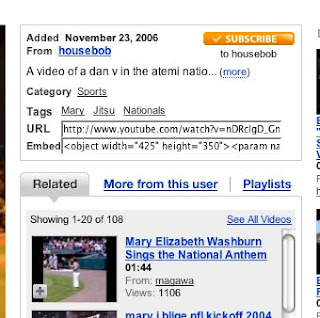
Now, to attach a video to your blog, you simply need to go to a video sharing site (I have used 'You Tube'), select the video you wish to use, as you do so, there will be a section that looks like this picture. You need to copy the code within the embed section, highlight the code shortcut key is apple/command + C for mac users or CRTL + C for PC users.
After this go to your blog, go to edit posts, or new posts, and paste the code apple/command + V or CRTL + V, into the html, hit the publish button. Wolla! You now have a video in your blog.
Video file sharing is massively involed in web 2.0/ social networking. There are many sites that invite users to upload video, for people to download, share and leave comments. The most established and recognised site is 'You Tube'. the content of the video can be practically anything, majority of the time the video's are produced by the users themselves. When you visit a video sharing site, there is normally an option to browse/search for video clips of a specfic genre e.g comedy, or in my case martial arts.

Now, to attach a video to your blog, you simply need to go to a video sharing site (I have used 'You Tube'), select the video you wish to use, as you do so, there will be a section that looks like this picture. You need to copy the code within the embed section, highlight the code shortcut key is apple/command + C for mac users or CRTL + C for PC users.
After this go to your blog, go to edit posts, or new posts, and paste the code apple/command + V or CRTL + V, into the html, hit the publish button. Wolla! You now have a video in your blog.
What's RSS
Today I learnt about RSS.
RSS, this means 'real simple syndication'.
RSS is part of a family of web feed formats used to send frequently updated data.
The principle of RSS is that it keeps you updated on a particular website by subscribing to its RSS feeds. For example if you regularly visit a website on cooking recipes, instead of repeatedly searching through web pages for this information, the information comes to you. However, not all websites offer RSS feeds, websites that do tend to have a RSS logo appear on the page in the url in certain web browsers e.g. firefox, or there's an option within the page, normally saying 'subscribe to feed' or a similar phrase.
To use RSS feeds, you have to use a program known as 'readers or aggregators . The RSS feeds are recieved by these programs, think of them as a mail box to recieve data.
RSS, this means 'real simple syndication'.
RSS is part of a family of web feed formats used to send frequently updated data.
The principle of RSS is that it keeps you updated on a particular website by subscribing to its RSS feeds. For example if you regularly visit a website on cooking recipes, instead of repeatedly searching through web pages for this information, the information comes to you. However, not all websites offer RSS feeds, websites that do tend to have a RSS logo appear on the page in the url in certain web browsers e.g. firefox, or there's an option within the page, normally saying 'subscribe to feed' or a similar phrase.
To use RSS feeds, you have to use a program known as 'readers or aggregators . The RSS feeds are recieved by these programs, think of them as a mail box to recieve data.
Subscribe to:
Posts (Atom)

